A few weeks ago, at an event, I had one of those conversations that happen more often than you might think. A founder told me he’d been watching customers leave steadily for months and couldn’t stop it. He was thinking about bringing in someone in Customer Success to look after his customers.
Knowing what I do, he asked if I could help him get started, because he had no idea where to begin. I said yes, and before we got into anything, I asked the question I always ask: what exactly do you want this person to achieve?
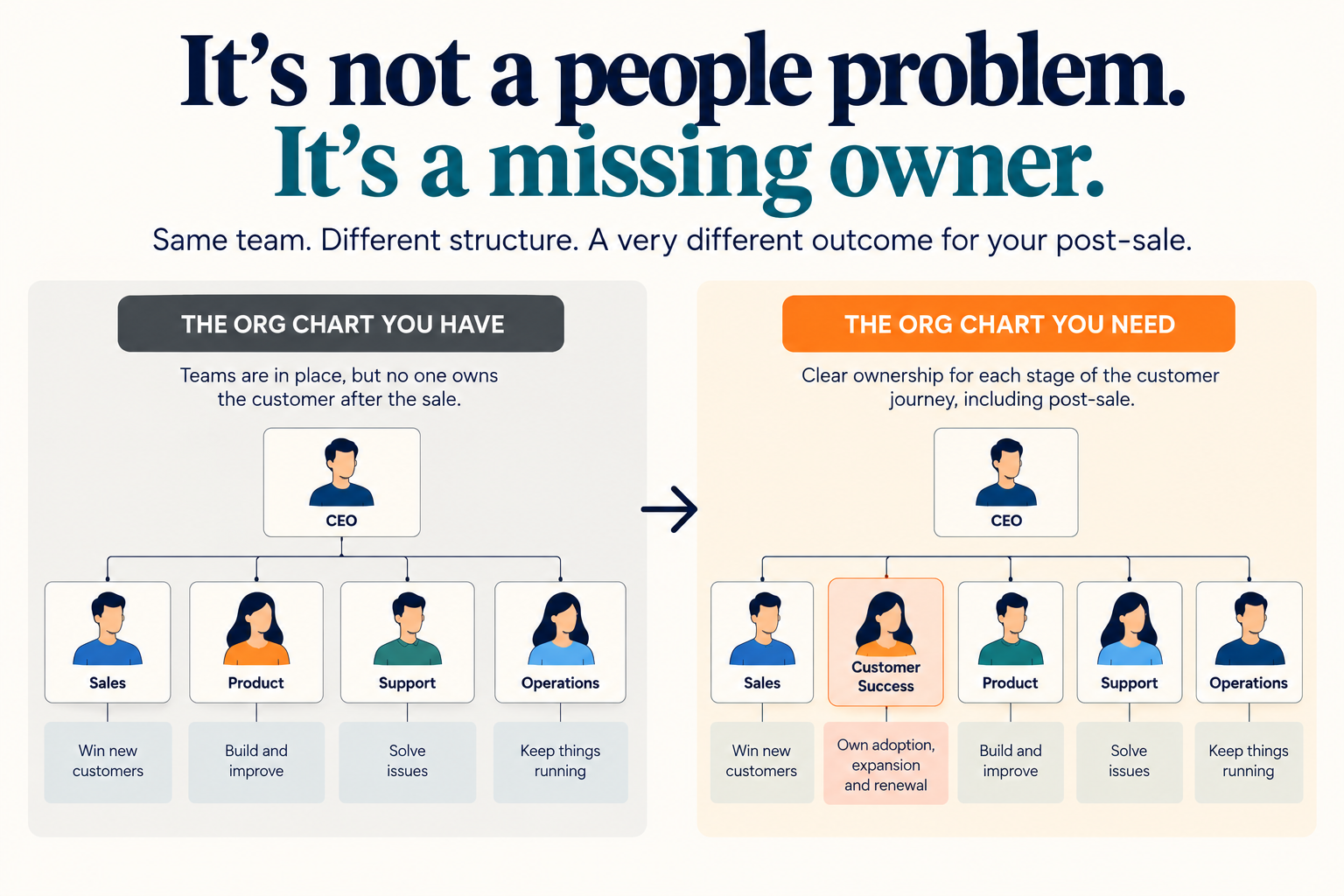
He told me he wanted to stop customers from leaving and expand the sales team to make up for those losses.
Both things, in the same breath. And no, it’s not the first time I’ve heard this. In fact, almost everyone has the same problem.
Because of course every company wants more customers, and there’s nothing wrong with wanting to sell more. The problem starts when selling more becomes a way to cover up the customers you’re losing without first understanding why they’re leaving. That doesn’t fix anything; it just puts off the bill.
And when you finally grow, with more customers, more people hired, and more infrastructure to support, that’s exactly when you shake the tree and realise all the apples fall at once, because they were never firmly attached in the first place. Growth doesn’t cause the problem; it reveals it. And if you don’t have strong customer relationships, it reveals the problem at the worst possible moment.
So today I’m sharing what I told him. It wasn’t a no, of course, but a list of the risks you take when you hire someone expecting them to solve retention on their own.
Risk 1: hiring doesn’t spread the work; it doubles it
Imagine you hire someone experienced and enthusiastic, who fits in well with the team and comes with ideas.
They arrive on Monday, sit down, and the questions nobody ever stopped to answer in writing begin:
- Which customer should they call first, and why that one rather than another?
- What tells them an account is losing interest?
- What do they do when they spot it?
- Where can we find customer information and the latest conversation with each customer?
If those answers don’t exist anywhere, the new person will ask whoever was already there, which in a small company is usually you. That’s why hiring doesn’t spread the work; it doubles it: your time doesn’t become free; you just spend it on someone else. Where you used to answer customer emails, you now answer questions from the team, explaining and justifying the same decisions you used to make yourself.
Risk 2: you burn someone out and draw the wrong conclusion
I’ve seen this end the same way several times:
A company puts someone in a full-time role looking after customers. Six months pass, and customers are leaving at exactly the same rate as before, except there’s now another salary on the payroll and plenty of frustration on both sides. Then comes the easiest conclusion, and also the most unfair one: that person wasn’t right for the job.
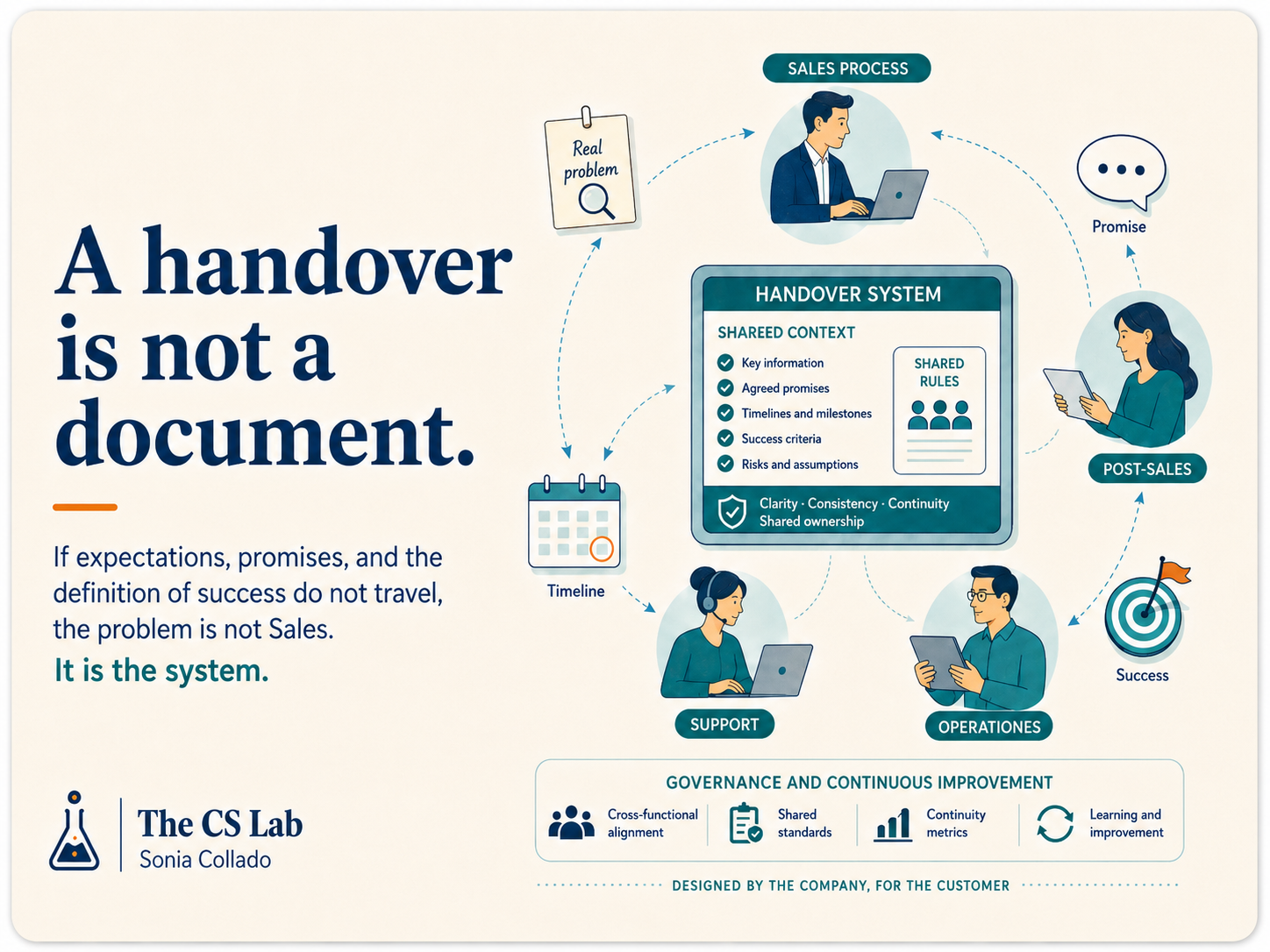
No, it isn’t always a problem with the person. What was missing was a set of criteria. Nobody had decided what to monitor, when to act, or how much discretion the person had, so they spent six months making reasonable decisions one by one, with nothing connecting them. And a collection of reasonable decisions without shared criteria doesn’t build anything you can repeat, let alone coordinate with other teams to bring everyone’s efforts together.
Risk 3: you’ll always be too late
This is the hardest part to accept, and I understand why: it’s the least intuitive of all.
Customers don’t decide to leave on the day they tell you they’re leaving.
By the time a customer tells you they’re leaving, they made that decision weeks or months ago. What you’re seeing at that moment isn’t the problem; it’s the end of the problem—the end of their problem, and of paying for something that brings them no benefit.
The point when you really could have done something came much earlier, and it passed quietly: someone stopped opening what you sent them, someone stopped showing up to meetings they used to attend, someone started taking three days to answer something they used to answer within an hour. None of that sets off an alarm, simply because there’s no alarm to set off.
Meanwhile, the company keeps watching the only thing it can see clearly: the customers coming in. That’s normal, and it isn’t poor judgment: new customers have names, dates, and sometimes even celebrations; customers who are drifting away only become visible when it’s too late to do anything.
Risk 4: you pay someone a salary to improvise
Without a system behind them, a person doesn’t end up doing Customer Success. They end up putting out fires with the best of intentions, attending to the loudest customer and letting the quiet one drift away, who is almost always the one who leaves. Not because they don’t know how to do better, but because without written criteria, urgency takes over. And urgency is set by the loudest customer, not the most valuable one or the one most at risk.
So, in practice, you’re paying someone a salary to improvise. The tricky thing is that they’ll improvise well for a while—well enough to make it look like it’s working, until you grow a little more and improvisation stops working.
This isn’t about your team not being good enough
When I talk about all this in a meeting, I never say it’s because the team isn’t “good enough.” When I speak with the team, I always find the same thing: people who work incredibly hard, know customers by name, and remember every detail of every account. And that’s where the real problem lies: they remember every detail of every account.
It’s not people who can’t scale; it’s the amount of decision-making knowledge stored in one person’s head. So when someone tells me their team is working flat out and customers are still losing interest, I don’t look at the team. I look at how many decisions depend on one person, how much knowledge hasn’t been written down, and how often someone has to ask a question before they can move forward.
The minimum foundations you need before hiring
I’m not talking about building a department, buying a tool, or stopping everything for a month. The ideal starting point is to sit down and assess what you already have and what you want to achieve, then design the process around that.
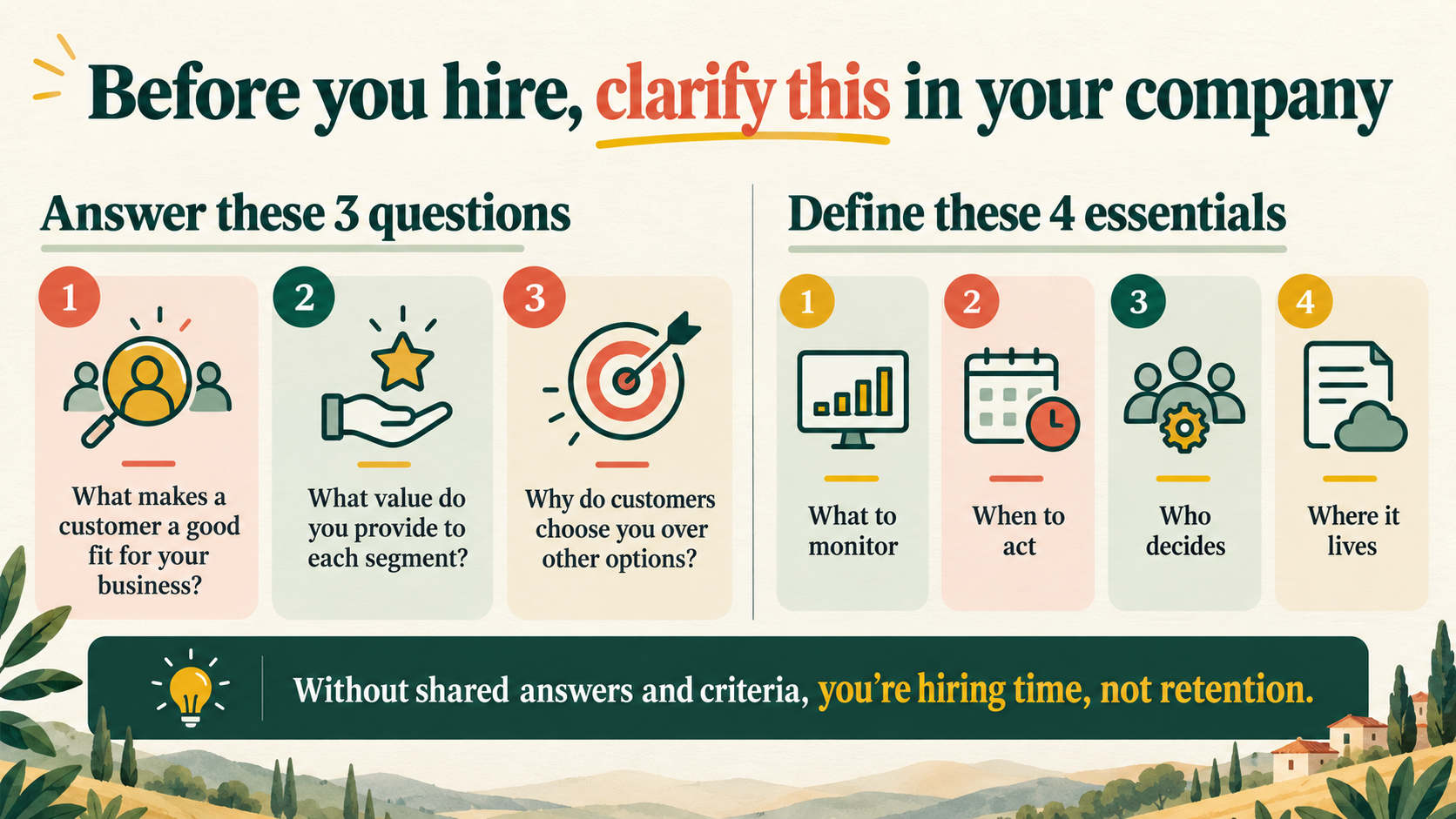
Before anything else, there are three questions I find unanswered in almost every company I speak with:
- What does a good customer look like to you? Not the one who brings in the most revenue—the quick answer and the one that always comes first—but the one who stays, uses what you sold them, recommends you, and doesn’t take up half the team’s time every week.
- What value do you place on each segment? Not all customers expect the same things from you or warrant the same level of effort. Treating everyone alike is the quickest way to end up giving everyone mediocre service and no one good service.
- Why do they choose you over someone else? This is the question that really makes people uncomfortable. If the answer isn’t written down and shared, each person on the team is defending a slightly different promise. Then the inevitable happens: the customer arrives expecting one thing and finds another.
Once you’ve answered those questions, there are a few essentials I always recommend looking at:
- What to monitor. Two or three signals, not fifteen. They should reflect actual behaviour, not perception: whether a customer uses the product, shows up, or asks questions. A feeling shared in a meeting isn’t a signal.
- When to act. A signal without a threshold is useless. If this falls below a certain point, or if a certain number of days pass without something happening, someone takes action. Without that threshold, everyone sees it and nobody acts, because nobody knows whether it’s their responsibility.
- Who decides. And how far they can go without asking. This is what frees up the most time for the founder and, strangely enough, what always gets written down last.
- Where to record it. One place, just one, that the whole team knows about. If everyone writes things in their own notebook, a year from now you’ll have nothing to consult and nothing to hand over to the next person who joins.
You don’t need a big budget to set this up. You need time and clear criteria. Once it’s defined and validated, you can hire, because the person who joins has something to work from on day one, and you can measure whether they’re doing a good job. Without that, you’re buying someone’s time, not retention.
To finish
If you’re thinking about expanding the team because you sense customers are losing interest, try a simple test before you start hiring. It won’t cost you anything:
If the person who currently manages your customer relationships went on holiday for three weeks tomorrow, would anyone be able to tell you which accounts are at risk and why?If the answer is no, hiring won’t fix the problem, because what’s missing isn’t more hands. You fix it by deciding what to monitor, when to act, and who decides.
And that’s exactly what I work on with the companies I collaborate with.It isn’t a dramatic or immediate change, and I won’t sell it as one. But you can clearly feel the difference from the inside: day-to-day work starts to gain structure, the team makes decisions without having to ask, there are fewer last-minute meetings to resolve the same old issues, and departments stop pulling in different directions and start working toward the same goal. There’s nothing magical about it: it’s writing down what used to live in three people’s heads.
And retention, which is where all this started, doesn’t improve because someone works harder. It improves because you stop finding out too late. When you’ve agreed on the signals and have a process for acting on them, the difficult conversations with customers happen three months earlier, which is exactly when they can still make a difference.
No matter how good that final call is, you can’t win back someone who has already decided to leave.
And it isn’t about retaining everyone, either. Some customers leave because they should never have signed up in the first place. More follow-up or more personal attention won’t fix that. You fix it by answering the first of those three questions: what does a good customer look like to you?
Where are you with all this?