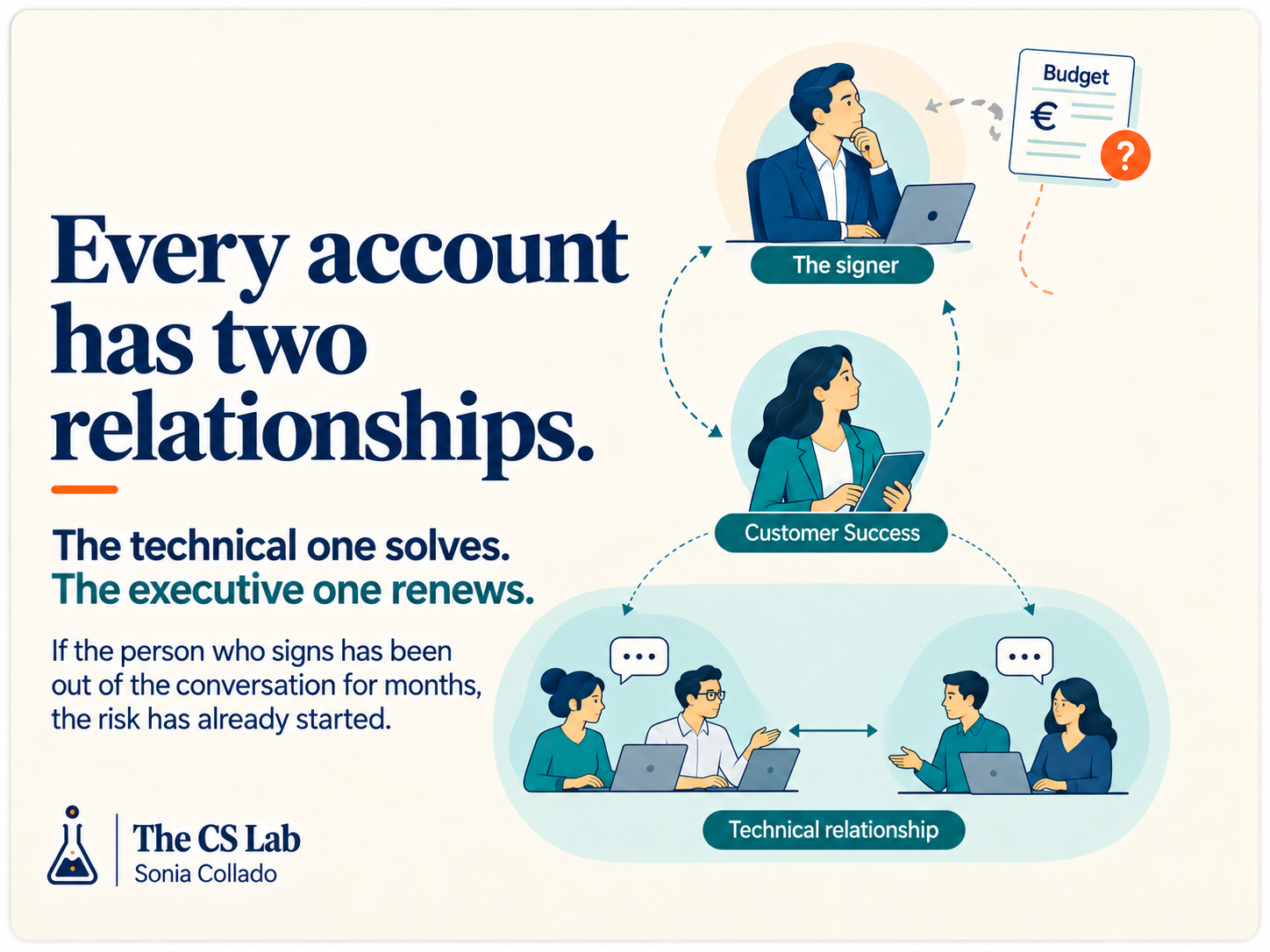
If you think your customer is going to renew because your technical teams work closely together, spoiler: that alone does not renew anything. The person who has to approve that spend may have gone a year and a half without knowing what you actually do.
I learned this after spending months sitting in meetings as a CSM where I barely understood half of what was being discussed.
Let me break it down.
Two technical teams, theirs and ours, discussing things at a level I simply couldn’t follow. I was sitting in the middle, watching the ball go from one side of the court to the other like a tennis match, taking notes about things I wasn’t even sure were important.
I’ll admit that, at first, I wondered whether I belonged there at all. And I know more professionals have had that feeling than are willing to admit it.
Over time, I understood why I did need to be there. Let me explain.
What the technical team does, and nobody else does
The first thing I understood in those meetings was that the real relationship with the customer wasn’t being built by me, but by the technical team, because in highly technical accounts, that’s how it usually works.
The technical team gets involved in the customer’s day-to-day operations and stays there. They adjust things, unblock issues, fix things that weren’t even in the contract because they are already there and because sometimes it is easier to do it than explain why they can’t. And that significantly improves the customer’s experience with the product.
Both teams learn how each company actually works beneath the org chart: who responds quickly, which process is broken or obsolete, and which things you really don’t want to touch on a Friday afternoon.
This kind of relationship is what builds a level of trust that you cannot create any other way: the trust of someone who has pulled you out of a difficult situation, someone you see as a colleague, someone you can rely on. And that never shows up in a report, but it leaves a mark on your day-to-day experience.
And yet there comes a point when, if you manage accounts, you need to put a limit on the effort and communication. Because that relationship we said doesn’t show up in reports was being built with the people who use what we sold, not with the person who would ultimately decide and explain why we should stay.
The person who hired you
They were the person who had identified the need before anyone else, the person who brought us into the company, the person who defended the spend in a committee where someone probably asked whether they could build it internally, and they said no.
And they took a risk by saying it.
That person lives somewhere else in the organization, reports to different people, is measured on different things, and operates in conversations that our technical contact may not even know about, nor should they necessarily know about: an upcoming reorganization, cost pressure coming from above, or a priority that changed during an executive meeting.
And they are the one, not the technical person, who will have to defend our renewal in a room where we won’t be present.
Once you understand this, the question changes. Inside your own company, you realize that you don’t just need another technical person. You need a Customer Success Manager managing the account, because someone needs to understand who is taking care of that relationship and who owns it.
What happens when the answer is “nobody”
The hardest thing for me to understand was that nothing happens.
Really, nothing.
The sponsor doesn’t get angry. They don’t complain. They don’t stop replying. The monthly meetings keep happening, problems get solved, the two teams understand each other better every month and everyone is reasonably happy.
The problem is that your sponsor starts disappearing from meetings and calls, and you lose touch with them.
That’s why it is so difficult to detect. There is no obvious warning sign. The people working with your product are still using it, the relationship is still active and “everything is fine” until, six months later, you realize you haven’t spoken to your sponsor in a very long time.
The problem shows up later, and somewhere else.
It appears when the contract comes up for renewal, when someone reviews the budget and asks what that line item is, and the person who once took a risk by bringing you in doesn’t have much to say.
Not because they don’t care about you, but because they have become disconnected, because they have spent a year and a half without really knowing what you have achieved together.
And from that point on, the conversation is no longer about whether you are doing a good job. It is about whether someone can justify the spend.
What someone in Customer Success looks for in a meeting they don’t understand
Let’s go back to the tennis match.
What took me a while to understand was that my job in that room wasn’t to follow the ball. It was to look at other things, such as:
-
Whether something has been stuck for three meetings and nobody is saying it. Technical teams have a very high tolerance for blockers because they see them as part of the job and keep moving. But someone needs to count how many times the same issue has come up and make sure it gets escalated early enough to be solved.
-
Whether we are doing too much. And most of the time, it happens with the best intentions. Someone asks for a favor, the technical person solves it because they can and because it is right there in front of them, and eventually it becomes the norm. The point is not to refuse to help. It is to make that extra effort visible at a higher level, during commercial conversations, so that if prices ever need to be adjusted, the customer doesn’t see it as an abuse of the relationship but as something consistent with the value being delivered.
-
Whether the person who trusted us knows what we are achieving and what they are achieving.
-
Whether the effort is always being carried by the same two people on the customer side. They are usually the people who help you the most, and they are exactly the ones who will eventually burn out or leave for another company because they are carrying too much. I have seen this firsthand. And when it happens, the account loses its institutional memory because that person was the one holding all of it in their head.
-
Whether another team, either theirs or ours, needs to be involved and nobody is asking for it. Many times, the blocker isn’t technical. There is simply someone missing from the room and new resources need to be brought in. And this doesn’t just unblock problems; it can make them move forward much faster.
As you can see, none of these questions is technical, and none of them is solved by fixing a specific problem.
The technical person is doing their job, and they are doing it well.
The answer is that you need another role and another layer of account management.
The uncomfortable part
Now let me get into another part I have seen. It is the “comfortable” part of the relationship, but also the uncomfortable part of doing this job. The part you don’t usually see in articles like this.
If someone from Customer Success is in that meeting and adds nothing, the problem isn’t always the meeting. It may be that their role is not being justified.
Sometimes, it is simply that we don’t know what to look for. That can happen once in a while.
But when it happens regularly, it is a signal that something is wrong. Someone is unnecessary in that meeting because we are investing significant resources every year in meetings where the work and the relationship remain entirely at the technical level.
And if we are there to listen instead of observe, we may not know the contract well enough to notice that we are going beyond scope. Or we may not understand the customer’s business well enough to know what matters to the person signing the renewal.
And if we cannot translate any of that for them, we are losing the most valuable renewal asset those meetings give us: the ability to provide context and visibility into what is actually happening at the technical level.
What you can do this week
Three concrete things you can do if you want to understand where you stand:
-
Write down, account by account, who uses the product and who signs the contract. If it is the same person, write down who else would have to approve the spend if there were a budget cut tomorrow.
-
Write down the date of your last contact with the person who signs. Not the technical contact. The person who signs. If it was more than a quarter ago, you already have your work for the next few weeks.
-
Before your next technical meeting, decide on three things you are going to look at that have nothing to do with the technical content. Even if you don’t understand a word of what is being discussed. Especially if you don’t understand a word of what is being discussed.
It’s not that the technical team doesn’t matter.
It does. A lot.
And it is probably the best relationship you have in the account.
The problem is that there are two relationships in every account, and one of them has been left unattended for a long time.