How to rebuild trust after a product failure
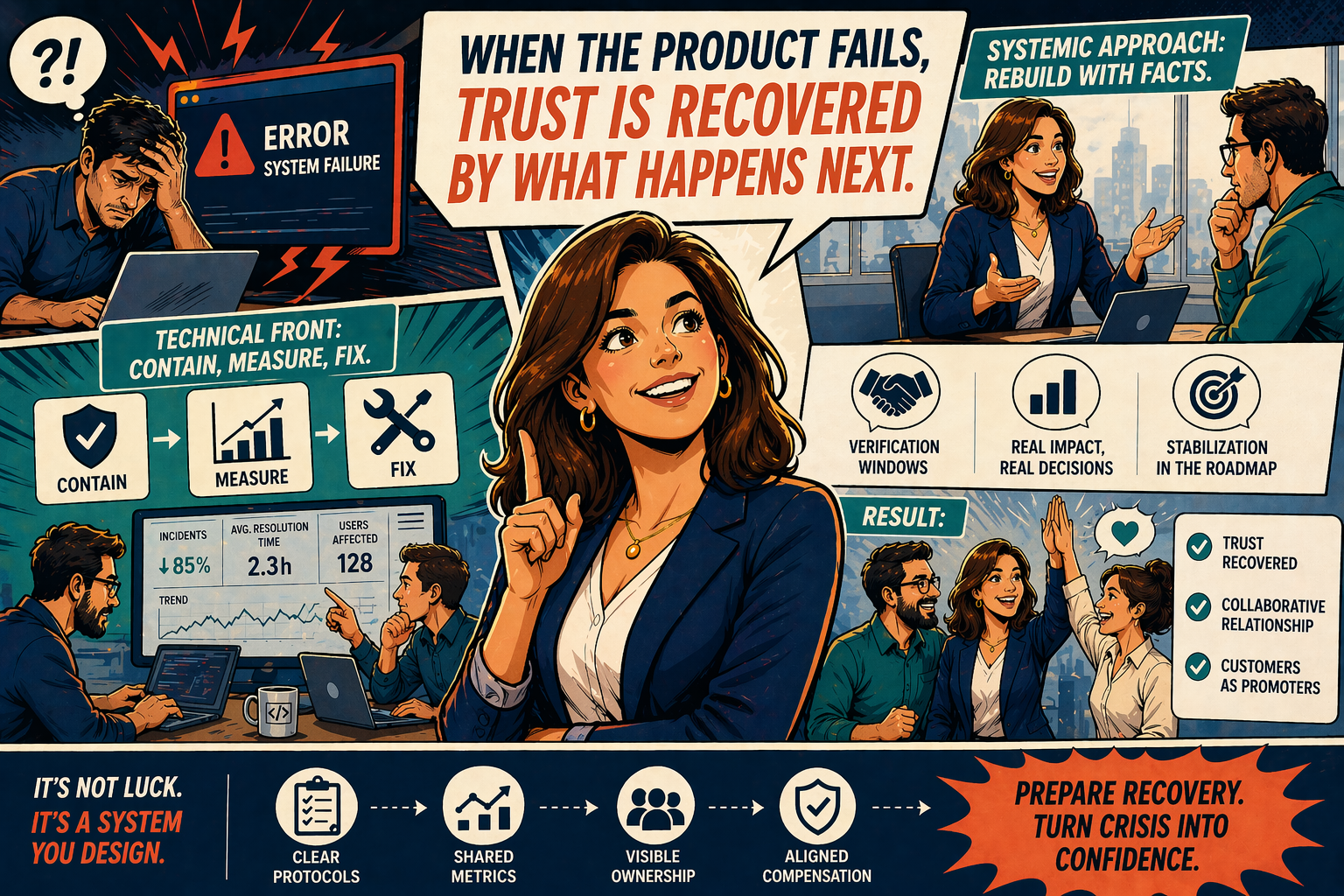
If the product fails, the bug is only the beginning. What really decides whether you lose or keep trust is what comes next.
And who hasn’t run into a major failure where the customer asks you questions you weren’t prepared for?
The ones you can’t answer with certainty about your product?
I don’t remember exactly which problem it was nor how it was fixed, but I do remember the customer’s reply weeks later:
“I’m not so worried about the failure. I’m worried that we didn’t know what to expect.”
That’s when something essential became clear to me: trust is broken more by uncertainty than by technical errors.**
For that reason, I now try to act on two fronts, simultaneous and coordinated. One technical. The other systemic.
Technical: contain, measure, fix.
Let’s not try to hide timelines or make vague promises. If we can publish progress updates with data from our problem-solving process, go ahead. No one expects perfection; they expect predictability.
Systemic: rebuild the relationship with verifiable facts.
We open verification windows with the customer. Let’s not throw the word “compensation” around at random: we define it according to real impact (usage data, lost opportunities, support cost) and we prioritize stabilization in the roadmap.
A strategic point: put Customer Success at the center of the response, not as reactive support, but as the architecture of trust.
That meant: a single point of contact for the customer, weekly reporting with metrics that matter to their business (incidents, mean time to resolution, affected users, impact on adoption), and transparency meetings where we shared both what we knew and what we didn’t.
We also changed how we measured internally, moving from just handling tickets to analyzing cohorts, and decisions began to be made with data, not intuition.
Result: the recovery wasn’t immediate, but it was tangible. The client’s NPS returned to previous levels and, more importantly, the relationship shifted from transactional to collaborative: customers who previously demanded answers started validating our mitigation hypotheses and even became promoters of our brand.
Lessons no one’s going to sell you in a “crisis management” playbook:
- Instrumental transparency: it’s not a moral stance, it’s risk management. Predictability mitigates the damage.
- Measuring the economic impact of the failure forces you to prioritize what really matters.
- CS isn’t a role that puts out fires; it’s the layer that connects product, engineering, and the customer when the business’s resilience is tested.
If your plan for “when the product fails” is reduced to a Slack thread and a manager who answers tickets, you’re doomed to recover trust by accident.
The alternative is to design it: clear protocols, shared metrics, visible responsibilities, and compensation mechanisms aligned with real damage.
Are you ready for trust recovery to be a repeatable practice, or are you going to wait for the next crisis to surprise you?Artículos relacionados