Why does your Customer Success team have to fix what’s broken in your company?
This story probably sounds familiar:
- CEO hires a Head of CS to “fix churn.”
- Head of CS hires two more CSMs.
- They implement onboarding playbooks.
- They create a health score.
- Churn doesn’t move.
- CEO concludes that “the team isn’t working.”
- Replaces the Head of CS.
- Restarts the cycle.
Spoiler of what you’ll see below: Here’s what you need to hear: 80% of retention problems in B2B SaaS aren’t Customer Success problems.
It sounds strange when you’ve already made the investment and waited months for answers and change, and when nothing comes, you think it’s CS’s fault.
The problem is that a CEO under pressure looks for the most obvious cause: if a CS team exists and leads retention; ergo, if there’s churn, it’s because CS isn’t working.
It’s logical, but let me tell you how this is experienced from the inside.
The typical story (from the Head of CS’s perspective)
A competent Head of CS joins a company, has experience, and knows what’s needed. In the first week they gather all the CSMs and ask basic questions:
• What does Sales promise that Product can’t deliver? • What customer feedback doesn’t reach Product? • How is it decided when CS is given authority to act? • Who knows a customer is at risk before CS realizes it?
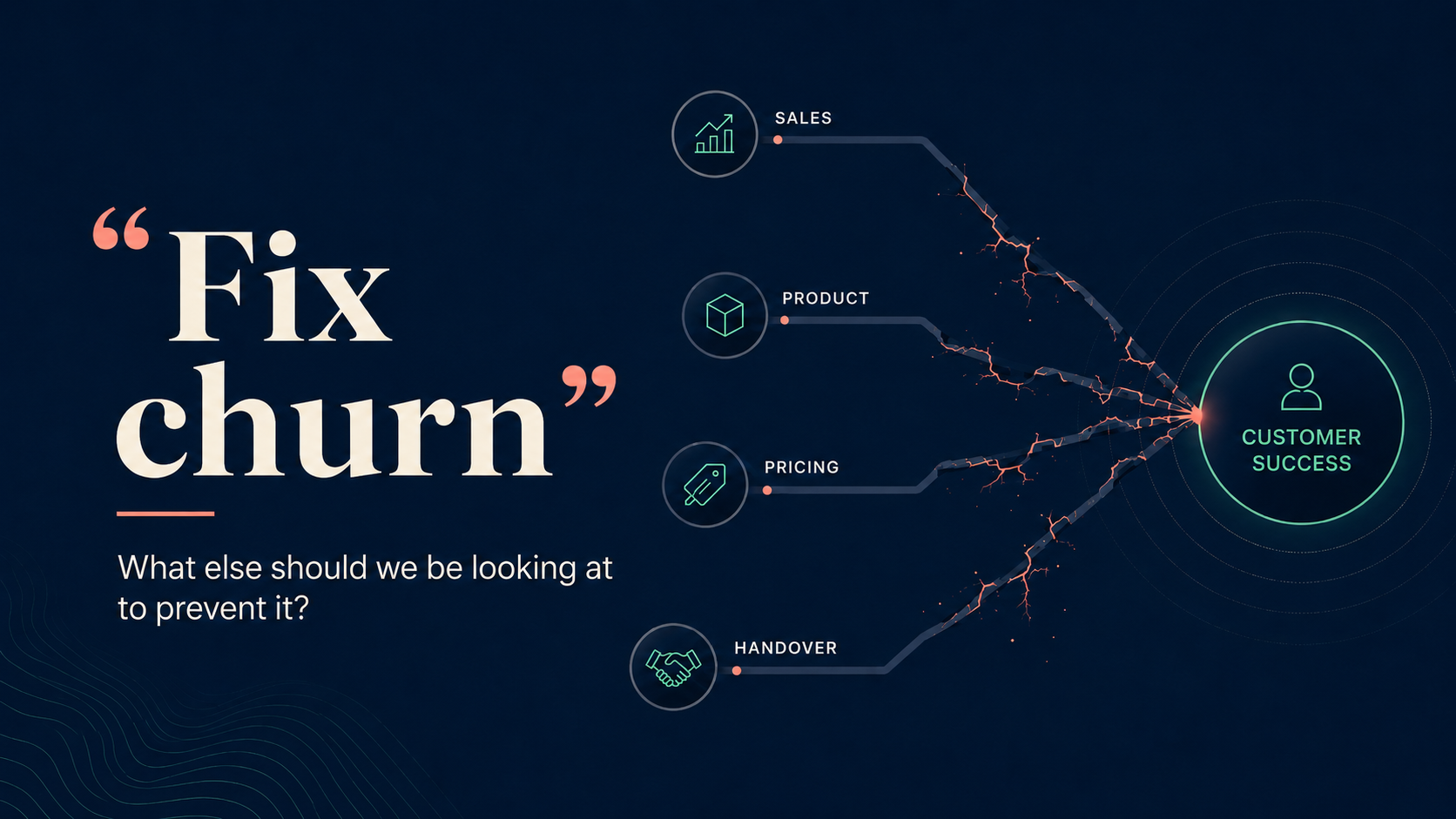
The answers reveal the 4 cracks you already know:
• Crack 1: Sales without restraint. The Account Executive (AE) has commission for a signature regardless of whether the customer is a real fit. And here comes one of the problems. The AE closes deals that should never have been closed and CS receives customers with imaginary budgets, use cases incompatible with the product, or expectations set in a 30‑minute call that CS never learns about. The Head of CS identifies this, reports it and it’s justified by the committee saying: “AEs are under number pressure. “We can’t afford to screen, we have to sell”.
• Crack 2: Product in its bubble. Sales says “the market needs X,” but your Product team says “it’s not on the roadmap.” Current customers have different pains that aren’t being addressed. The Head of CS is the voice of the customers who leave, but the roadmap is committed and they can’t address it. The Head of CS identifies this, reports it and they say: “Product has its own priorities, besides we have to sell and the market clearly asks for new features that must be satisfied”. Each time a product becomes harder to maintain.
• Crack 3: Handover on paper. Sales passes information to the CSM in a document, or in a quick meeting. The CSM has to rebuild the customer’s story from scratch, where sometimes they discover promises Sales made that aren’t documented. The Head of CS identifies this and proposes a structured handover. It’s a coordination job between teams, not CS’s job.
• Crack 4: Pricing without visibility. Someone gives discounts without CS knowing. The customer arrives with destroyed margins and expectations of further price cuts. The customer ends up being unprofitable. The Head of CS can’t grow an account that’s already at the maximum discount. Also, those customers tend to consume a lot of resources. The Head of CS identifies this, reports it and they say: “Negotiations are confidential and are Sales’ business”.
Of the 4 cracks, exactly one is CS’s responsibility. The other three are decisions about how the organization is built, that is, by the CEO, Sales, Product, Finance, …
But when churn doesn’t go down, who do you blame? The one in the middle of all the cracksseeing everything collapse: the Head of CS.
Why “more playbooks” don’t fix this
Within post‑sales, the typical cycle usually goes like this:
• YEAR 0: We hire a Head of CS. They seemed brilliant in the interview. • MONTHS 3–6: The Head of CS diagnoses. Proposes changes. They’re told “be patient.” They start documenting processes. • MONTHS 6–12: Nothing changes operationally, but now we have playbooks. Churn doesn’t move. • MONTHS 12–15: The Head of CS is frustrated. The CEO is frustrated. The conclusion is: “This Head of CS can’t scale.” • MONTHS 15–18: The Head of CS leaves or is replaced. They hire someone “more experienced.” • The new Head of CS arrives and does… exactly the same thing. Because the system is still the same and guess what, churn stays the same.
The reason is simple: you can’t make up for a broken system with individual talent.
A playbook doesn’t fix Sales closing non‑fit customers, nor does a health score fix Product not listening to the customer, nor does an excellent CSM fix a nonexistent handover. What fixes this is organizational architecture.
What Customer Success really is (spoiler: it’s not “just” a department) Here comes the line you probably don’t want to hear: Customer Success isn’t just another department, it’s a decision about how your company is built.
When you say “I’m going to hire a Head of CS,” you’re not hiring someone to fix churn. When you hire that profile, what you’re saying is “I’m going to put a person in the middle of all my post‑sale operations to try to manage the chaos and the revenue.”
And when this happens, the organization is structured from retention, from the customer.
• Sales has retention metrics in their bonus. Not just signatures. Retention. • Product has a process where CS and Support provide real signals of usage and churn. • The handover between Sales and CS is mandatory and structured. • Pricing consults CS before giving large discounts. • The CEO reviews retention as a central business metric, not as a delegated responsibility.
When you do this, Customer Success stops being “the team that manages the chaos” and becomes “the team that designs how customers succeed from day one.”
That’s the difference between a Head of CS with authority and one without authority.
The conversation you need to have: If your NRR is below 100%, you need to have an uncomfortable conversation with yourself.
Because the question isn’t: “Is my Head of CS okay?”
The questions you should ask yourself are:• Is my organization structured for retention? • Why do customers choose us and how do we add value? • Does Sales have a retention incentive or only a signing incentive? • Is there a process where Product listens to CS or does CS compete for attention? • Is the handover between Sales and CS mandatory or is it a suggestion that depends on whether the AE has time? • Who can give discounts without CS knowing? • Do you really know where churn is going or do you only have the NRR number?
If you don’t know the answers, or if the answers are “it’s complicated” or “it varies,” then the problem isn’t your Head of CS or Operations department, it’s architecture.
What happens when you fix it:
When a CEO decides that retention is everyone’s responsibility (not just CS), things happen with impact:
• Sales starts filtering leads. • Some AEs leave because they can’t close anything anymore. Those who stay begin to understand retention as part of their job. • Product begins to receive clear retention signals and is obliged to take them seriously. They’re not suggestions. They’re real data and pains from your customers. • The handover stops being a document nobody reads and becomes a structured meeting with all parties. Trust between teams increases and strategy is based on data. • Pricing consults CS, because sometimes there’s an alternative that works better for both the customer and the company. • The Head of CS suddenly has authority. Because they’re not alone fighting the system. The system works and their role is key to the company’s growth.
For you
The next time you look at your NRR, before blaming the CS team, look at your organization and answer the questions above because that difference is everything.
If you want a Head of CS to be truly effective, build an organization where retention isn’t CS’s responsibility, but everyone’s.
And that way, your investment in Customer Success will be justified and you’ll stand out in the market for your retention and expansion.
Artículos relacionados